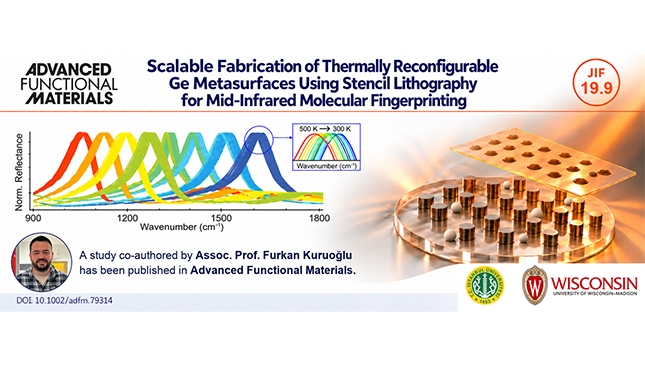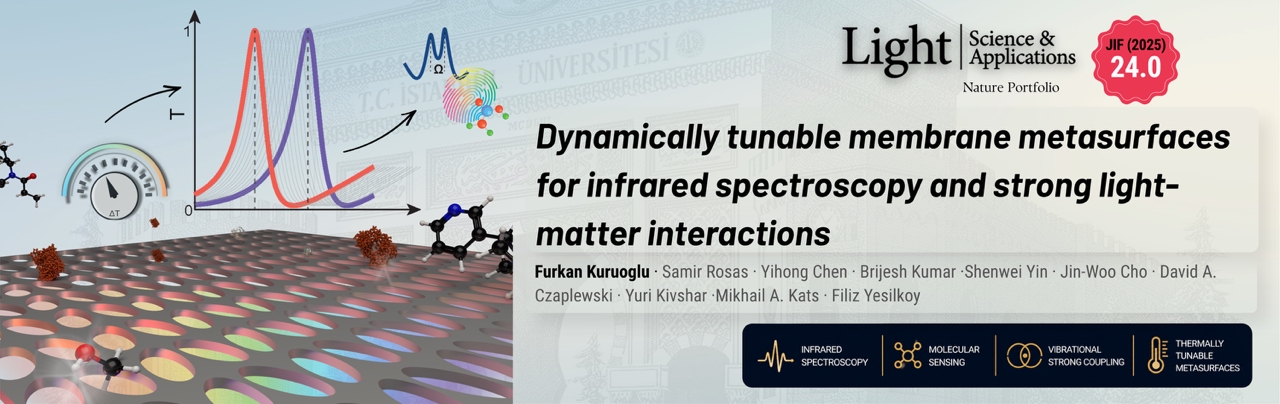
An international study involving Assoc. Prof. Furkan Kuruoglu, a faculty member of the Department of Physics, has been published in Light: Science & Applications, one of the most prestigious journals in optics and photonics, with a 2025 Journal Impact Factor (JIF) of 24.0.
The study, titled “Dynamically tunable membrane metasurfaces for infrared spectroscopy and strong light-matter interactions,” presents thermally tunable silicon membrane metasurfaces supporting high-quality-factor transmission resonances in the molecular fingerprint region. By exploiting the thermo-optic properties of silicon, the researchers continuously tuned the resonances across a spectral range of 23.5 cm⁻¹ over a temperature range of 300–700 K.
The developed platform enabled imaging-based identification of the characteristic molecular absorption bands of polystyrene and PMMA films without requiring the samples to be deposited directly on the metasurface. This provided an experimental demonstration of a non-contact chemical analysis approach that does not rely on conventional spectrometers.
The metasurface resonance was also dynamically swept across the carbonyl vibrational band of PMMA. Strong coupling between the molecular vibrations and the photonic resonance resulted in a Rabi splitting of approximately 43 cm⁻¹, demonstrating active control of hybrid light–matter states.
By combining high-quality-factor resonances, strong electromagnetic field enhancement and dynamic tunability within a single structure, the platform offers new possibilities for compact mid-infrared spectroscopy, sensitive molecular detection and programmable polaritonic photonics.
The research was conducted through an international collaboration involving Istanbul University, the University of Wisconsin–Madison, the Australian National University and Argonne National Laboratory. The study was supported through Assoc. Prof. Furkan Kuruoglu’s research under the TÜBİTAK 2219 International Postdoctoral Research Fellowship Program and by the Istanbul University Scientific Research Projects Coordination Unit.
Access the article: https://doi.org/10.1038/s41377-026-02382-7