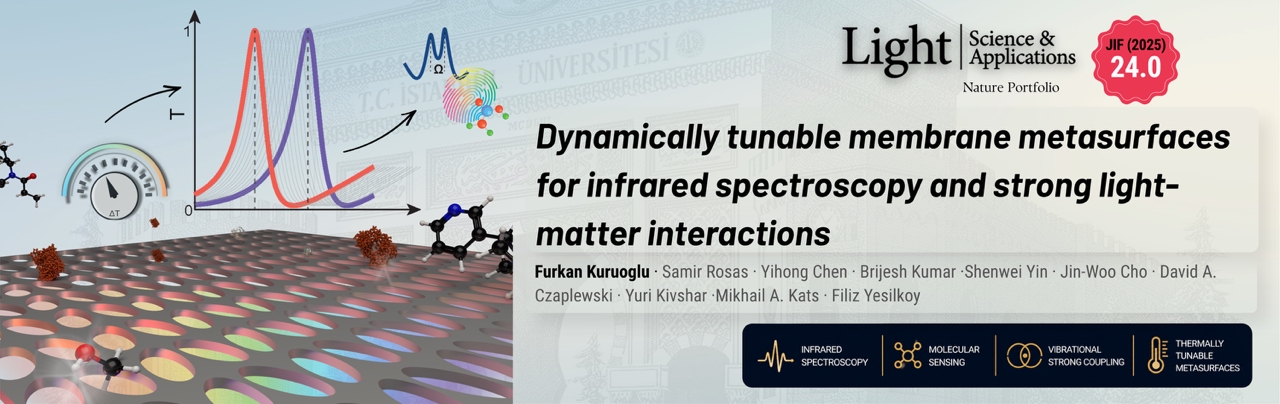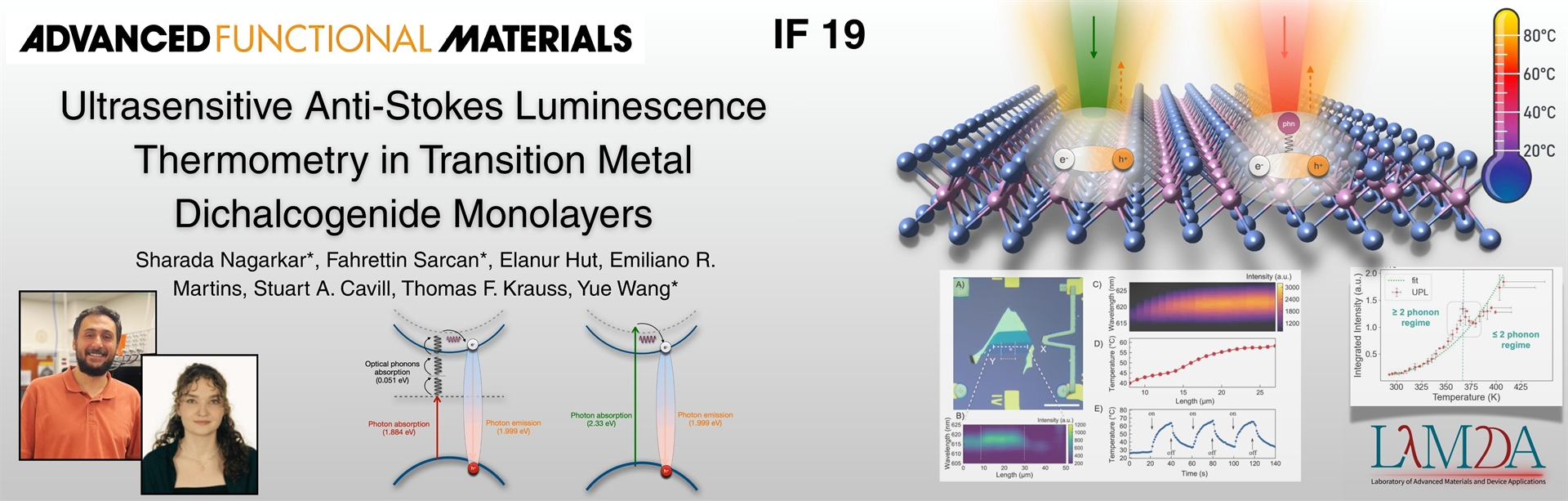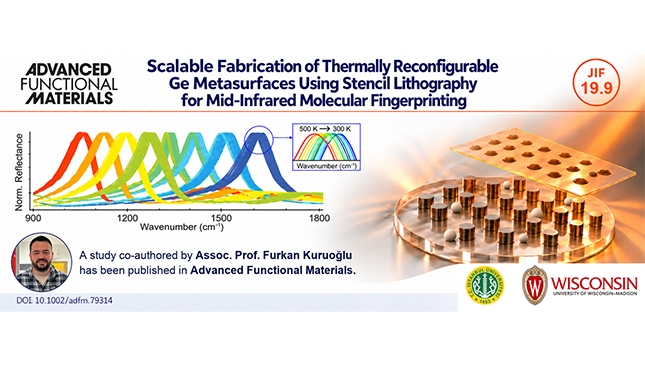
The study “Scalable Fabrication of Thermally Reconfigurable Ge Metasurfaces Using Stencil Lithography for Mid-Infrared Molecular Fingerprinting,” co-authored by Assoc. Prof. Furkan Kuruoğlu of our Faculty’s Department of Physics, was carried out as part of a project led by Prof. Filiz Yeşilköy at the University of Wisconsin–Madison and published open access in Advanced Functional Materials (Wiley-VCH, 2025 Journal Impact Factor: 19.9).
The study developed thermally tunable metasurfaces made of germanium (Ge) pillars to detect the characteristic molecular vibrations that serve as “fingerprints” in the mid-infrared region. Using silicon nitride stencil masks that can be mass-produced by standard UV lithography, Ge was patterned over large areas on CaF₂ substrates in a single deposition step without the use of resist. Different pillar geometries on the same chip provided resonances spanning 950–1700 cm⁻¹, while the thermo-optic effect of germanium allowed these resonances to be reversibly shifted by approximately 36 cm⁻¹ over a temperature range of 300–500 K.
Tuning the resonances through temperature after fabrication allows the optical response of the metasurface to be precisely aligned with the vibrational bands of a target molecule. This capability was used to reconstruct the vibrational spectrum of thin PMMA films over 1100–1215 cm⁻¹ and to detect a monolayer of polystyrene microparticles through their characteristic bands at 1450 and 1492 cm⁻¹. The results suggest that this approach, which combines scalable fabrication with dynamic spectral tuning, could be used for polymer analysis and microplastic detection.
Reference: S. K. Biswas, S. Rosas, W. Adi, A. Beisenova, V. Unnikrishnan, F. Kuruoglu, F. Yesilkoy, “Scalable Fabrication of Thermally Reconfigurable Ge Metasurfaces Using Stencil Lithography for Mid-Infrared Molecular Fingerprinting,” Advanced Functional Materials (2026). https://doi.org/10.1002/adfm.79314